Evaluating Agentic Intelligence with Production

How we went from observability to evaluation: Golden datasets, RAGAS metrics, and LangFuse feedback loops that made agent quality a measurable number.
The Problem
After we shipped our Ecosystem Agent, the agentic RAG system that unified Docs, Academy, Storybook, and Marketplace behind a single Ask-AI, the roadmap did what roadmaps do. Better re-ranking. New indexing strategies. Model upgrades. Prompt refinements.
Every enhancement raised the same question: did this change make the system better, or did it quietly break something?
For a while, we answered it manually, running a fixed set of real developer questions against the system and reviewing every answer before release. It worked, barely. And it made one thing obvious: manual verification of intelligence does not scale. It was becoming the bottleneck on our own velocity.
Shipping an agentic system without evals is a blind game. The team's response was the same as last time. Don't add more process. Build the missing layer.
Observability Is Not Evaluation
We had full tracing from day one. Every agent invocation, every routing decision, every retrieval fan-out, all visible in LangFuse. It is essential infrastructure, and it answers every question except the one that matters.
A trace tells you what the agent did. It cannot tell you whether what it did was right. The trace of a confidently wrong answer is indistinguishable from the trace of a correct one: same clean retrieval, same healthy latency, same tidy graph.
Observability is the flight recorder. Evals are what keep the plane in the air. Teams conflate the two, and it costs them. Dashboards stay green while answer quality drifts.
Tracing tells you what happened. Evals tell you if it was any good.
Golden Datasets + RAGAS: Quality Becomes a Number
Agent quality is not one number. It spans everything from schema checks to end-to-end goal completion, the same way a testing pyramid spans unit tests to exploratory QA. We started where our risk actually lived, with two investments.
A golden dataset built from production, not imagination. We pulled real developer queries from traces, including the odd ones, and paired each with an expected outcome. Fifty scenarios to start. Production reality, frozen into test cases.
RAGAS to score every change against it. The metrics map onto exactly the failure modes of a knowledge agent:
- Faithfulness, Context Precision and Recall: is every answer grounded in retrieved knowledge, or is the model freelancing?
- Tool Call Accuracy: did the orchestrator fan out to the right knowledge sources, with the right arguments?
- Agent Goal Accuracy: end to end, did the developer's objective get met?
- Topic Adherence: did the agent stay within its mandate?
The impact was immediate. A release-day afternoon of manual review became a pipeline job. A model upgrade decision stopped being "answers feel better" and became: faithfulness up, tool routing stable, cost per query down. Ship it.
What took an afternoon of eyeballing now takes a CI run. And unlike the afternoon, the CI run never gets tired.
Closing the Loop with LangFuse
Evals without observability are tests without telemetry. Observability without evals is telemetry without judgment. The system needs both, connected:
- Production traffic flows through the agent, fully traced.
- Interesting traces (failures, edge cases) are curated into the golden dataset.
- RAGAS scores every change against that dataset, offline, before merge.
- A CI gate blocks any release that regresses the baseline.
- Online evaluators (LLM-as-judge, user feedback) score live traffic continuously.
- Scores land back in LangFuse: quality, cost, and latency in one place.
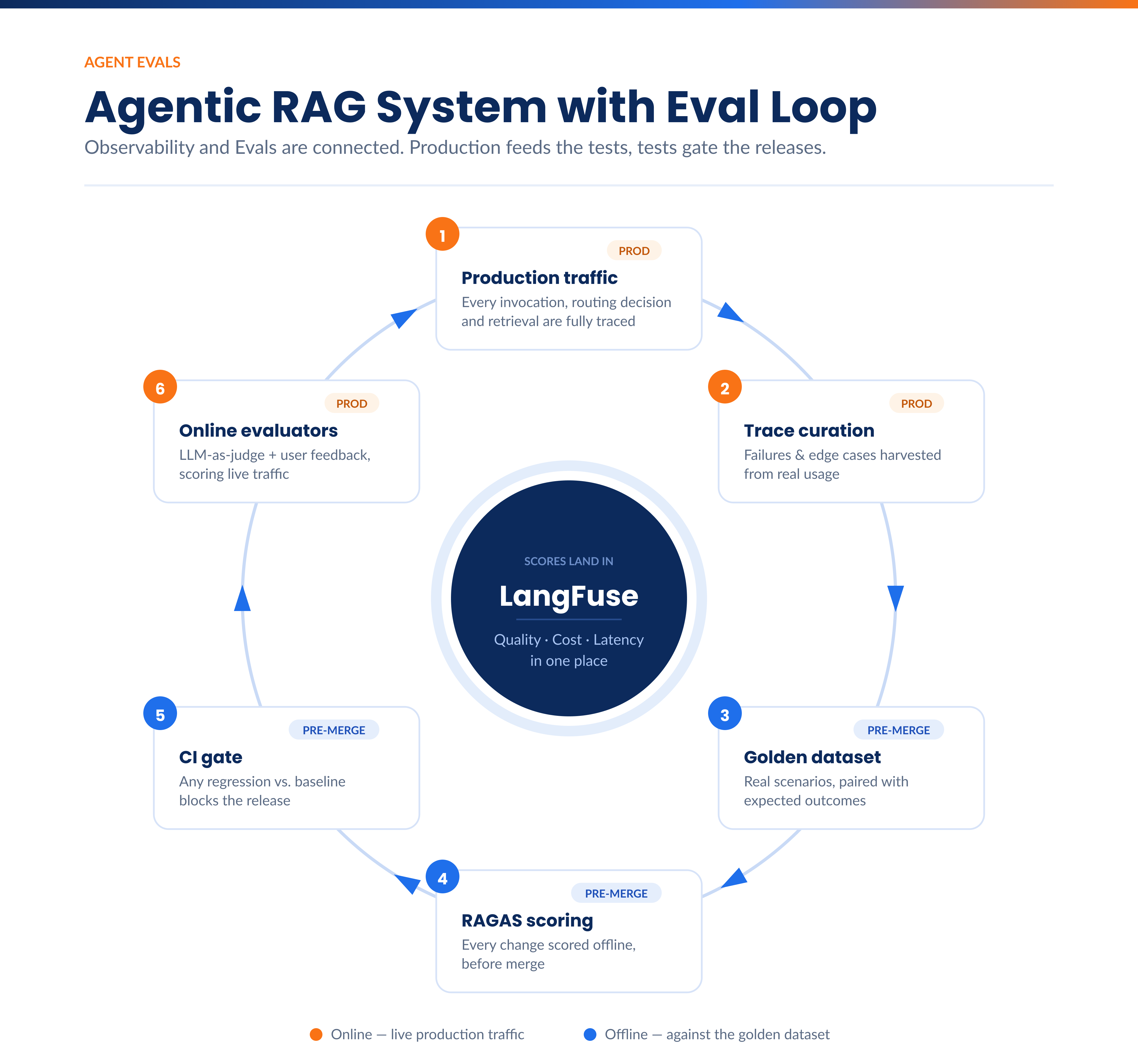 Observability and Evals are connected. Production feeds the tests, tests gate the releases.
Every production failure becomes next sprint's test case. Eval coverage compounds for free.
Impact: What Actually Changed
| Before | After | |
|---|---|---|
| Release verification | An afternoon of manual review per change | A CI run, on every commit |
| Model & prompt decisions | "Answers feel better to me" | Faithfulness, routing, and cost deltas on a scorecard |
| Regressions | Discovered by users, reported as tickets | Blocked at the merge, before release |
| Quality visibility | Invisible between incidents | Tracked continuously, next to cost and latency |
Closing Thought
Build for production. Learn from production. Measure in production.
Last time, I ended with the first two clauses. Shipping evals taught us the third.
None of this required a research team. Tracing, fifty golden scenarios, three RAGAS metrics, and a CI gate got us from vibes to numbers.
A team that answers "how good is our agent, and is it getting better?" with a number will always out-ship a team that answers with a feeling.
Evals are how you earn the right to move fast. Everything else is a blind game.